
Why clearing land costs so much in California
It's not your imagination — clearing brush in California costs more than almost anywhere. Chemicals are restricted, labor is expensive, and slopes eat machines. Here's the breakdown.
Get a few quotes for clearing a brushy California hillside and the numbers can be startling — often several times what the same work costs in other states. That's not price-gouging; it's four structural forces stacked on top of each other. Understanding them explains a lot about why grazing keeps winning bids on hard terrain.
1. The chemical shortcut is fenced off
In much of the country, the cheap answer to vegetation is spraying. California has systematically narrowed that option. Glyphosate — the workhorse herbicide — has been on the state's Proposition 65 list as a chemical known to the state to cause cancer since 2017, and many cities, counties, school districts, and land agencies have restricted or banned its use on public land. Add buffer requirements near waterways, endangered-species habitat rules, and drift liability near crops and homes, and large-scale spraying is legally awkward where it isn't prohibited outright.
Whatever you think of the underlying science debate, the practical effect is the same: on sensitive California land, the chemical shortcut often isn't available — vegetation has to be physically removed or eaten.
2. Labor here is the most expensive in the country
Hand crews are the fallback for terrain machines can't reach, and hand crews are priced in California labor. The state minimum wage reached $16.90 in 2026 — with many cities higher — and agricultural and landscape work carries daily-and-weekly overtime under AB 1066, plus workers' compensation premiums that reflect how dangerous slope work with chainsaws and brush cutters actually is. A multi-person crew working steep chaparral by hand costs thousands of dollars per acre, and the state's own studies of herder wages show labor costs across the vegetation-management industry still climbing.
3. Slopes break machines (and machines start fires)
Masticators and mowers are cost-effective exactly where California's fire problem isn't: flat, open, rock-free ground. On the steep canyon walls and rocky hillsides that carry fire toward homes, equipment operates slowly, unsafely, or not at all — most tracked equipment has hard slope limits, and one boulder can end a mower deck's day. Worse, steel blades striking rock throw sparks: mowing equipment has ignited its share of California wildfires, which is why agencies restrict mechanical work on hot, windy afternoons — precisely the season when the work is needed.
4. Everything you cut has to go somewhere
Mechanical and hand clearing produce slash — cut brush that must be chipped, hauled, or burned. Hauling means trucks and dump fees; burning means permits and narrow burn windows; chipping means machinery on ground that may not support it. Disposal quietly adds a meaningful share to most clearing bids.
Where goats rewrite the math
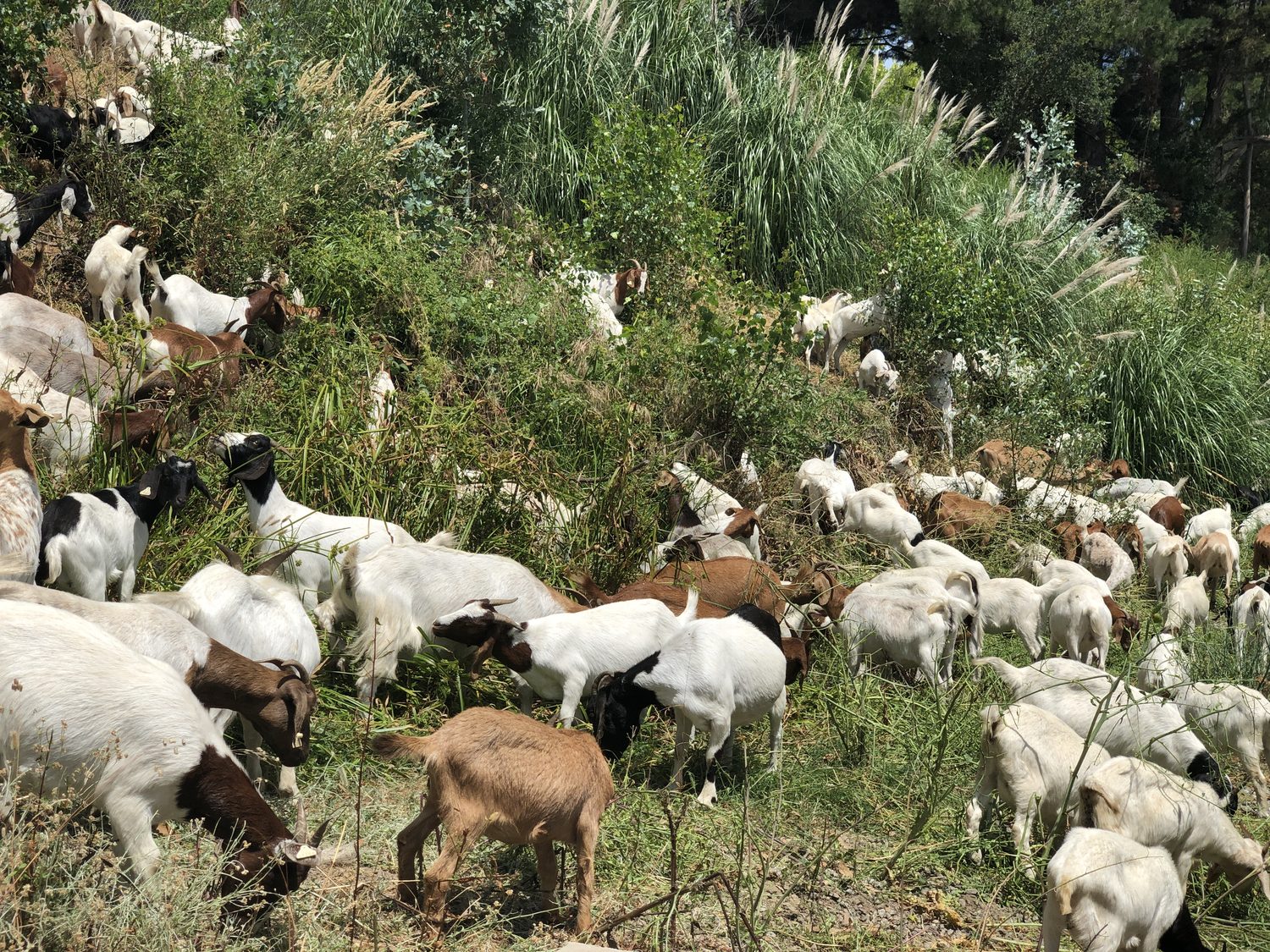
Grazing doesn't dodge California's costs — herds come with fencing, water, transport, and herders who are themselves subject to the state's wage laws. But it sidesteps all four cost drivers at once where they bite hardest: no chemicals (so restricted land is fair game), no per-hour crew scaling with terrain difficulty (goats climb for free), no spark risk (so work continues through red-flag season), and no disposal (the vegetation leaves inside the goat). That's why on steep, brushy, sensitive, or poison-oak-covered ground, grazing bids routinely come in at a fraction of hand-crew quotes — while on flat, clean grass, a mower is still your cheapest friend. We're honest about both halves of that; see our full comparison of goats vs. mowing, herbicides, and machines.
The bottom line
California land clearing is expensive because the state has made the cheap options — spraying, cheap labor, careless machinery — unavailable or unwise, mostly for defensible reasons. The winning move isn't to fight that; it's to pick the method whose costs don't scale with California's constraints. On hard terrain, that's frequently the one with hooves. Here's what actually drives grazing prices.
Sources
- OEHHA — Glyphosate listed under Proposition 65 (effective July 7, 2017)
- California DIR — Minimum wage (2026: $16.90)
- California Agriculture (UC ANR) — California sheep and goat ranchers adjust to wage increases
- California DIR — AB 1066 overtime phase-in for herders
Get a quote for the terrain machines can't touch
Talk to a real person about your property and get a free estimate over the phone — we serve properties across California and generally require about a 5-acre minimum per project.
Call 1-858-751-GOATSee how it works