
Goats vs. mowing, herbicides, and machines
Every brush-clearing method has trade-offs. Here is an honest side-by-side of goats against the machines and chemicals people usually reach for first.
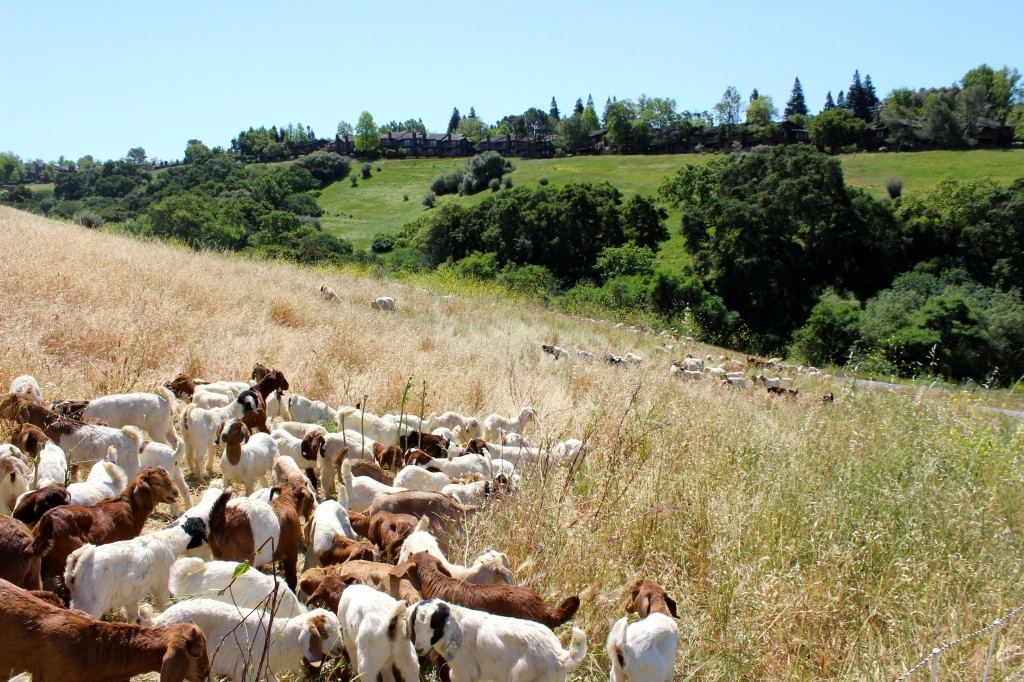
When brush gets out of hand, most people reach for a mower, a crew with chainsaws, or a sprayer. Goats are the newer option on that list — and for the right property, they solve problems the others can't. Here's an honest comparison so you can pick the right tool (which is sometimes a combination).
At a glance
| Method | Steep terrain | Chemicals | Debris left behind | Soil impact | Best for |
|---|---|---|---|---|---|
| Goat grazing | Excellent — steep, rocky, brushy | None | None — goats eat the material | Aerated and fertilized by manure | Large, overgrown, or hard-to-reach parcels |
| Mowers & masticators | Flat, clear ground only | None (but fuel/emissions) | Leaves cut mulch layer | Compaction; blades can spark in dry brush | Open, level, accessible sites |
| Hand crews | Good but slow | None | Must be hauled or chipped | Minimal disturbance | Precise edges and finishing work |
| Herbicides | Any, but restricted near water | Chemical residue | Leaves dead standing fuel | Runoff / pollinator concerns | Spot treatment of specific weeds |
Terrain: goats go where machines can't
This is the biggest practical difference. Mowers and masticators are fast on flat, cleared ground but can't safely work steep slopes, canyons, or rocky embankments — and in dry conditions, metal blades striking rock can throw sparks. Goats climb that terrain comfortably, which is why they're so popular on California hillsides and in the wildland-urban interface.
Chemicals and water: a cleaner footprint
Herbicides can be effective for spot-treating specific weeds, but they leave chemical residue, are restricted near waterways and sensitive habitat, and don't reduce the biomass that's already there — they leave dead, dry standing fuel behind. Goats introduce no chemicals at all, which makes them a common choice near creeks, ponds, and reservoirs where spraying isn't allowed.
Debris and dump fees: nothing to haul
Cutting brush — by machine or by hand — creates a second job: hauling or chipping what you cut, often with dump fees attached. Because goats eat the vegetation on site, there's typically no cut material to remove. That also means no mulch layer left to smother new native growth.
Soil and ecosystem health
Heavy machines can compact soil and tear up topsoil. Goats do the opposite: their hooves lightly aerate the ground while their droppings return nutrients as natural fertilizer. Their selective browsing targets invasive brush and weeds, which can give native and dormant plants room to come back. Popular coverage often cites large reductions in carbon footprint versus fuel-burning equipment; the exact figure varies by site, but the direction is clear — grazing avoids the fossil-fuel emissions of mechanical clearing.
The hidden cost of manual labor
Hand-clearing looks cheap on paper until you add it all up. Crews with chainsaws, brush cutters, and string trimmers are billed by the hour, and dense or steep acreage is slow, physical work — so the hours stack up fast. On top of labor, someone has to rake, pile, haul, and dump what's cut, which means truck time and landfill fees. Steep or poison-oak-covered ground raises the safety burden (and the price) further. Goats sidestep most of that: the herd works around the clock, clears terrain crews can't safely stand on, and eats the material instead of leaving it for someone to remove.
Cost: competitive, and it depends
For many California properties, goat grazing is competitively priced against hand crews and heavy machinery — especially once you factor in that there's no debris hauling or dump fees. Pricing depends on acreage, vegetation density, terrain, access, water, herd size, and season. See what affects the cost of goat grazing for the full breakdown. (We avoid blanket "always cheaper" claims — for a small, flat, easy lot a mower may win; for large, steep, or brushy land, goats often pull ahead.)
So which should you use?
Often, more than one. Goats are ideal as a first pass and for ongoing seasonal maintenance on large, overgrown, or steep parcels — then hand crews or machines can finish precise edges, remove trees and stumps, or complete a fire break. Herbicides can play a targeted role for specific persistent weeds. The best plan matches the tool to the terrain.
Sources
- Cal Poly — Goats as a land-management tool
- iForest (2014) — Goat grazing as a wildfire prevention tool: a basic review
- Gardening Know How — Using goats to clear land and control weeds
- NPR (2023) — How goat grazing helps fight California wildfires
Ready to clear your property naturally?
Talk to a real person about your property and get a free estimate over the phone — we serve properties across California and generally require about a 5-acre minimum per project.
Call 1-858-751-GOATSee how it works