Sheep or goats: which does your land actually need?
They get lumped together, but sheep and goats eat completely different landscapes. Here's how to tell which one your property needs — and when the answer is both.
People use "goat grazing" as shorthand for all targeted grazing, but the two animals we run are near-opposites in what they eat. Choosing wrong wastes money: goats on a grass field graze reluctantly and unevenly; sheep in chaparral simply can't do the job. Here's the practical decision guide we walk clients through — and yes, despite the name, Rent A Goat rents sheep too.
The one-sentence version
Sheep eat down; goats eat up. Sheep are grazers — heads down in the grass, cropping fine fuels short and uniform across open ground. Goats are browsers — heads up in the brush, stripping leaves, vines, and woody regrowth to about six feet, on terrain that would twist a mower into scrap.
Match the animal to the vegetation
- Annual grasses, grassy hillsides, weedy fields → sheep. Grass is the "flashy fuel" that ignites first and carries fire fastest, and sheep remove it more thoroughly and evenly than goats will.
- Brush, chaparral, blackberry, poison oak, ladder fuels → goats. This is browse — goats prefer it, tolerate the toxins in it, and climb the slopes it grows on.
- Vineyards and orchards → sheep. Off-season sheep manage row middles without browsing vines or stripping bark. Goats in a vineyard are a cautionary tale.
- Solar sites → sheep. They fit under panels and leave equipment alone. The 2024 NREL/American Solar Grazing Association census counted over 113,000 sheep grazing roughly 129,000 acres of U.S. solar facilities — solar grazing is now a mainstream industry, and it's a sheep industry.
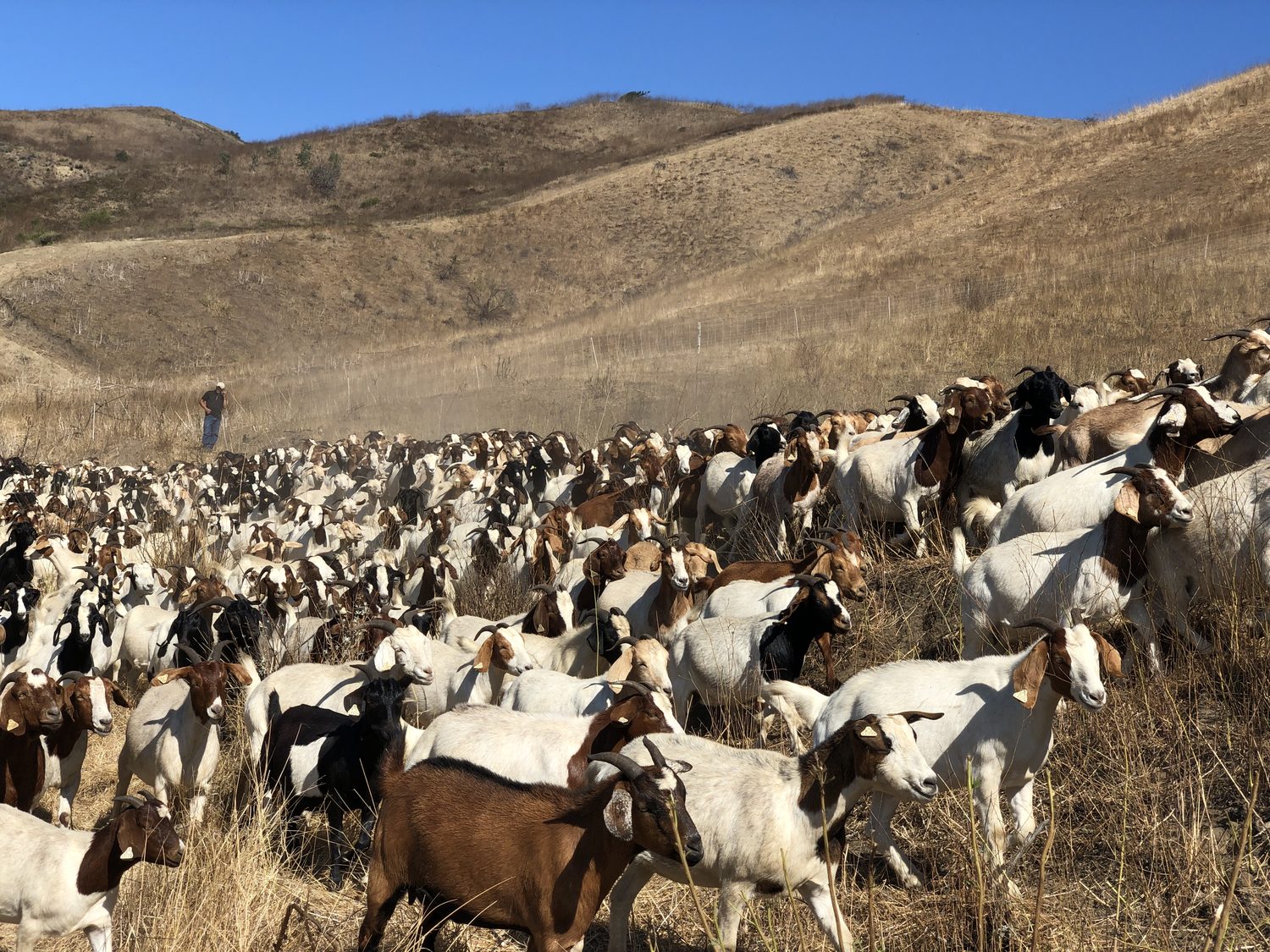
- Mixed grass-and-brush properties → both. A combined herd works both vegetation layers at once; this is extremely common on California fuel-reduction projects.
Behavior differences that matter on site
Sheep flock tightly and are easier to hold on open ground; goats are independent, curious, and legendarily hard on fencing — part of why professional projects use energized netting and daily herder checks regardless of species. Goats will test (and climb) anything, which is exactly the trait that makes them brilliant on rock and terrible near equipment. Both run with livestock guardian dogs in predator country, and both projects look identical from the client side: fencing, water, herder, done.
Fire-fuel reduction: usually a two-animal answer
A typical California defensible-space property has grass in the open, brush on the slope, and ladder fuels at the tree line. Research on targeted grazing treats sheep and goats as complementary tools: sheep flatten the fine-fuel layer that ignites, goats remove the brush and ladder fuels that let fire climb. Our companion piece on sheep vs. goats for grazing covers what the research says; the short version is that the best fuel reduction on mixed vegetation comes from running both.
The bottom line
Don't pick the animal — describe the land, ideally with photos, and let the vegetation pick. It's the first thing we assess in every estimate, and it's why the estimate form asks what needs clearing.
Sources
- NREL / American Solar Grazing Association — U.S. Solar Grazing Census (2024)
- Frontiers in Sustainable Food Systems (2025) — Sheep grazing as sustainable vegetation management for solar energy production
- Smart Practice review — Vegetation management utilizing sheep grazing within utility-scale solar (Small Ruminant Research, 2025)
Grass, brush, or both — we've got the herd for it
Talk to a real person about your property and get a free estimate over the phone — we serve properties across California and generally require about a 5-acre minimum per project.
Call 1-858-751-GOATSee how it works