
The census: solar grazing went mainstream
The U.S. Department of Energy’s National Renewable Energy Laboratory (NREL) and the American Solar Grazing Association counted the industry for 2024 and found more than 113,000 sheep grazing roughly 129,000 acres of utility-scale solar sites across the country. Their conclusion: the scale of solar grazing is “much larger than previously understood and undergoing rapid growth.”
The logic is simple. Solar arrays sit on grassy land that must be kept low so vegetation never shades panels or creates fire risk — but the ground under and between panels is awkward, shaded, and cable-strewn, which makes mowing slow, expensive, and risky. Sheep fit under the panels, work every corner, and leave the equipment alone.
New research: the land benefits too
A 2025 study published in Frontiers in Sustainable Food Systems, based on research at a Pennsylvania solar site, found sheep grazing improved soil health on solar farms — with higher soil organic matter and active carbon on grazed sites — while the sites in turn provided good forage for the flocks. A companion review in Small Ruminant Research reached similar conclusions while mapping what’s still unknown.
In other words, the arrangement isn’t just cheaper vegetation management; it looks like genuinely regenerative land use.
Why sheep and not goats
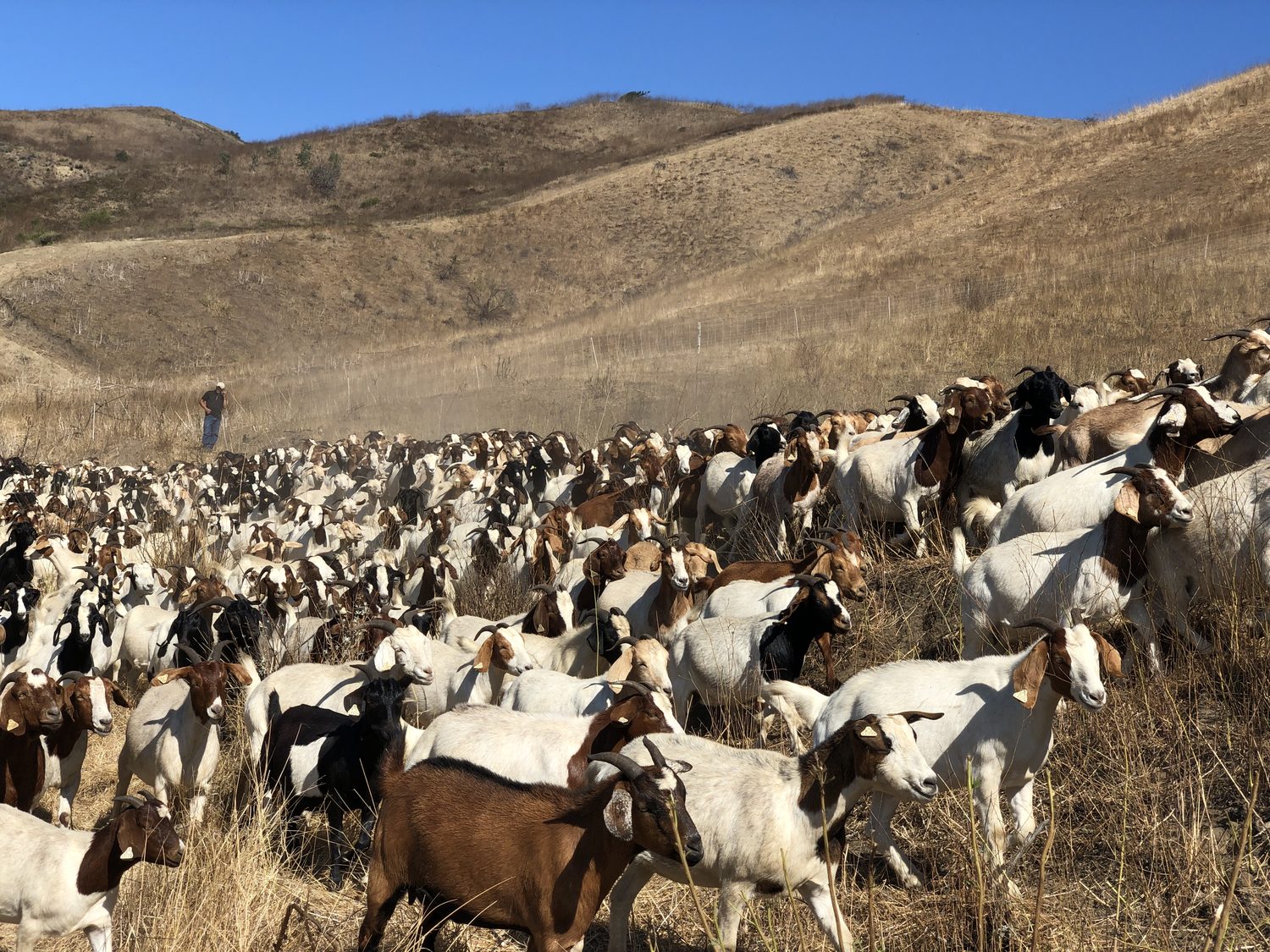
This is a job description written for sheep: the vegetation is grass, the terrain is flat, and the site is full of wiring and hardware. Sheep graze heads-down and ignore the equipment. Goats — brilliant on brush and slopes — would treat a solar array as a climbing gym with chewable cables.
It’s a tidy illustration of the rule behind every targeted-grazing project: match the animal to the land. Grass and open ground, sheep. Brush, slopes, and poison oak, goats. Both, a mixed herd.