
The problem: an invasive reed that crowds everything out
Phragmites australis — the common reed — is one of the most aggressive invasive plants in North American wetlands. It forms dense stands up to fifteen feet tall, displacing native plants and degrading habitat for birds, fish, and other wildlife. Land managers have spent decades and millions of dollars fighting it, mostly with herbicides and mechanical cutting.
Duke University marine biologist Brian Silliman has studied the reed for roughly two decades, searching for an approach that is both effective and sustainable.
The finding: two goats, a dramatic reduction
In fenced test plots at the USDA’s Beltsville Agricultural Research Center in Maryland, Silliman and colleagues found that a pair of goats reduced Phragmites cover from about 94 percent to 21 percent, on average, over the course of the study. Broader field experiments run by Duke and six other U.S. and European universities found controlled goat grazing could cut the reed’s stem density by roughly half in about three weeks.
The team concluded that grazing animals — goats in particular — offer a lower-cost, lower-chemical alternative to conventional control, especially in sensitive wetland areas where herbicide use is restricted.
Why it matters for California land managers
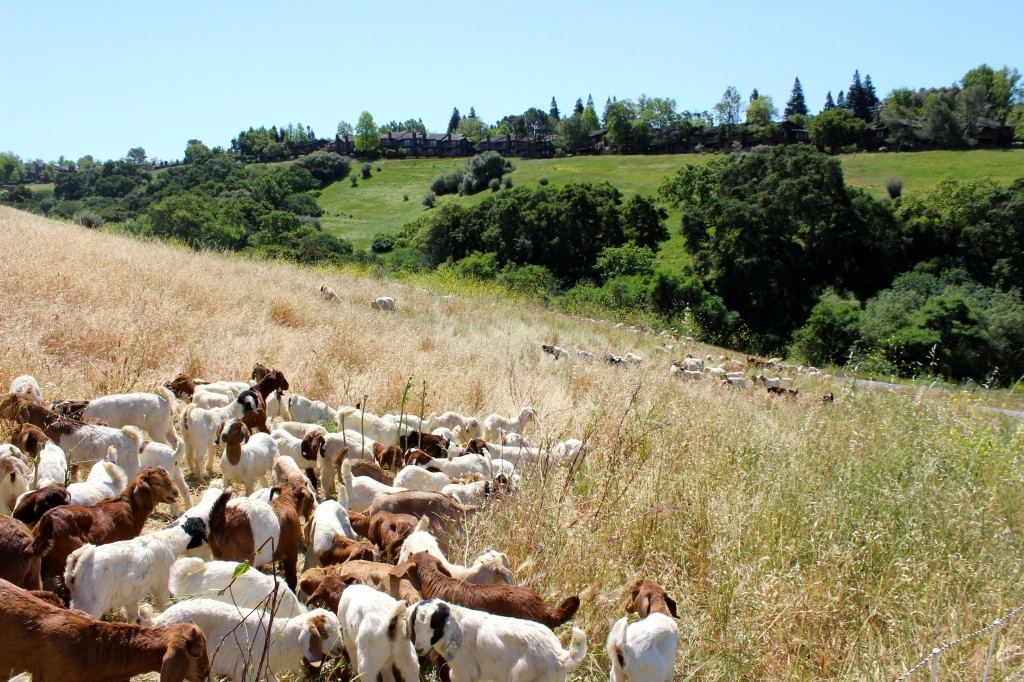
The specific target here is a marsh grass, but the principle generalizes: goats will readily consume tough, fast-growing vegetation that crews find slow and expensive to remove, and they do it without synthetic chemicals. That is exactly the logic behind using targeted grazing for brush, weeds, and fire fuel on California hillsides.
Research like this is part of a growing scientific literature supporting prescribed grazing as a legitimate vegetation-management tool — not a novelty.