
Less than 10 acres? How to get goat grazing on a smaller property
Most professional herds work on projects of about 10 acres or more. If yours is smaller, you are not out of options. Here is what actually works.
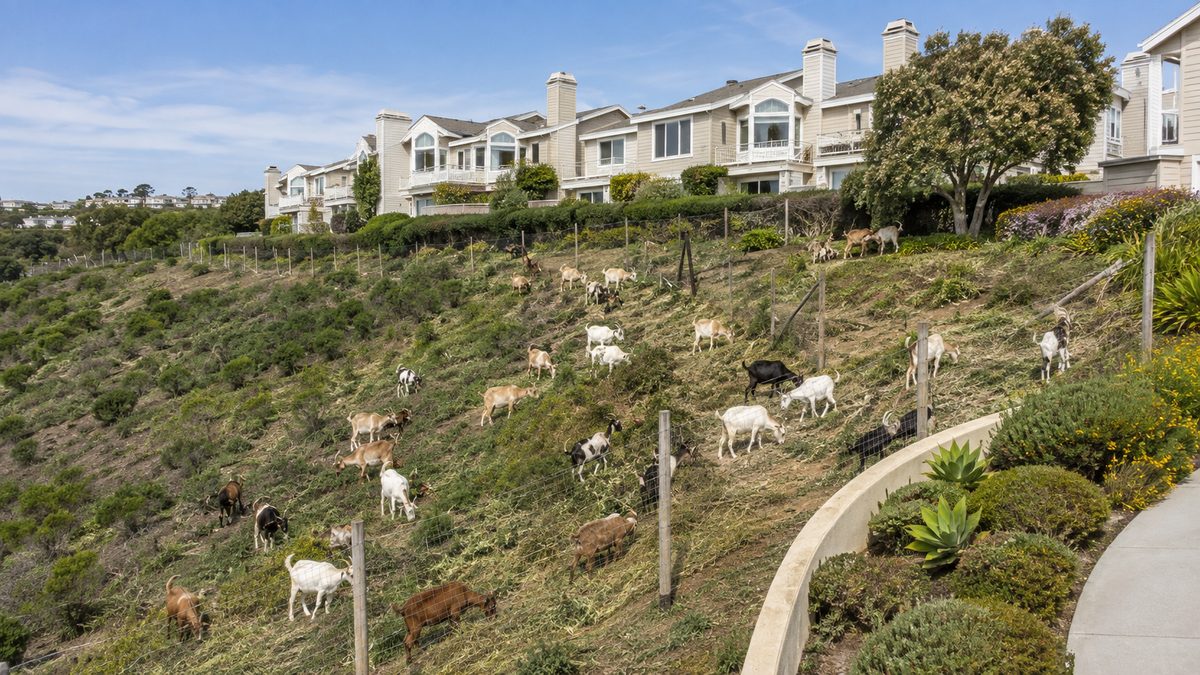
If you have called around about hiring goats and heard "we need about 10 acres," that can sound like a door closing. It is not the whole story. The minimum exists for a reason, and there are several practical ways around it. Here is the honest version.
Why there is a minimum
A professional grazing herd is not a few goats in a pickup. It is a few hundred animals, a livestock trailer or several, temporary electric fencing, water, a herder and guard dogs. Getting all of that to your gate costs about the same whether the job is 2 acres or 20. On a small lot, the transport and setup would be most of your bill and most of the trip's footprint. That is why we generally require about 10 acres per project: it keeps cost and transport emissions reasonable for you and for us.
There is a second reason. A large herd clears roughly an acre a day, so a small lot is finished in hours. A herd that size is also built for big, uniform jobs. It is the wrong tool for a half-acre backyard.
Option 1: Team up with your neighbors
Brush and fire risk do not stop at property lines, and neither does a fenced grazing cell. If the properties next to yours have the same problem, scoping them together can bring the total to a viable size. This works best when:
- The parcels are adjacent or close together, so the herd moves between them without a new setup each time.
- Every owner agrees to the same dates and gives access for fencing and a trailer.
- One person acts as the point of contact and collects acreage, photos and addresses for the estimate.
Send the group's combined acreage, the addresses and a few photos, and we can tell you quickly whether it works.
Option 2: Go through your HOA, Fire Safe Council or district
Many small lots sit inside a larger area that already has a shared problem: a greenbelt, a slope behind a row of houses, a drainage corridor or a wildland edge. Homeowner associations, community services districts, fire districts and local Fire Safe Councils can hire one project that covers the shared land, and the cost is spread across many households. If you are on a board, our guide to writing grazing into an HOA or municipal bid explains how to scope it. If you are a resident, ask your board or council whether a shared project makes sense. Funding may also be available: see grants that pay for goat grazing.
Option 3: Use a different tool for a small lot
Goats are the best answer on large, steep or brushy ground. On a small, flat, accessible lot, other tools can be simpler and cheaper, and it is better to know that than to force a bad fit:
- Mowing or string trimming for grass and light weeds, as long as it is done early in the day and not on dry, windy days when a spark can start a fire.
- A hand crew for dense brush near structures, where precision matters. See goats versus hand crews for how the costs compare.
- A small local herd. Some small operators and farms rent a handful of goats for backyards and small lots. They are not a substitute for a working herd, but they can fit a lot a professional herd cannot serve. Check their insurance and how they manage fencing and water before you book.
- Doing the defensible-space work yourself, starting with the areas closest to the house. Our defensible space checklist shows what to do first.
What not to do
Do not buy a few goats and tether them. A tethered goat cannot move away from a predator or a hot afternoon, and a small group working a big patch will take a very long time. We cover the reasons in renting versus buying goats.
How to find out if your project qualifies
Call or send your address, rough acreage and a few photos. If your land, or your land plus your neighbors', is close to the minimum, say so. If we cannot help, we will tell you plainly and try to point you to someone who can.
Sources
Ready to talk about your property?
Talk to a real person about your property and get a free estimate over the phone — we serve properties across California and generally require about a 10-acre minimum per project.
Call 1-858-751-GOATRequest a Free Estimate