
What is actually burning outside Bordeaux
The fire threatening the Bordeaux metropolitan area is running through pine forest and scrubland that has been parched by heatwave after heatwave since May. By Sunday it had covered roughly 42,000 hectares — about 162 square miles — and more than 250,000 people had been evacuated from Gironde and Landes. France’s interior minister described a fire “generating its own winds and advancing erratically.”
That last phrase is the technical heart of the story. A fire generates its own wind when it is releasing enough energy to drive its own convection column, and it releases that much energy when there is enough continuous, dry fuel to feed it. Weather sets the conditions; fuel sets the ceiling on how violent the fire can get.
Continuity is the variable
Fire behavior depends on three things: weather, terrain, and fuel. Two of those are fixed. You cannot negotiate with a wind event, and you cannot flatten a slope. Fuel is the only one a landowner or an agency can change on purpose, before the season, on a schedule.
And the property of fuel that matters most is continuity — whether the vegetation forms an unbroken carpet a fire can run through, and whether it is stacked in layers that carry flame from the ground into the canopy. Southwestern France’s maritime pine plantations and understory scrub are a nearly ideal arrangement for that. So are the chaparral slopes, oak woodlands, and annual grasslands that back onto a great many California properties.
This is why the same headlines recur in Provence, in Portugal, in Greece, and in Sonoma County. It is not that these places are unlucky. It is that they grow similar fuel, dry it out on a similar schedule, and then get wind.
Where grazing fits — and where it does not
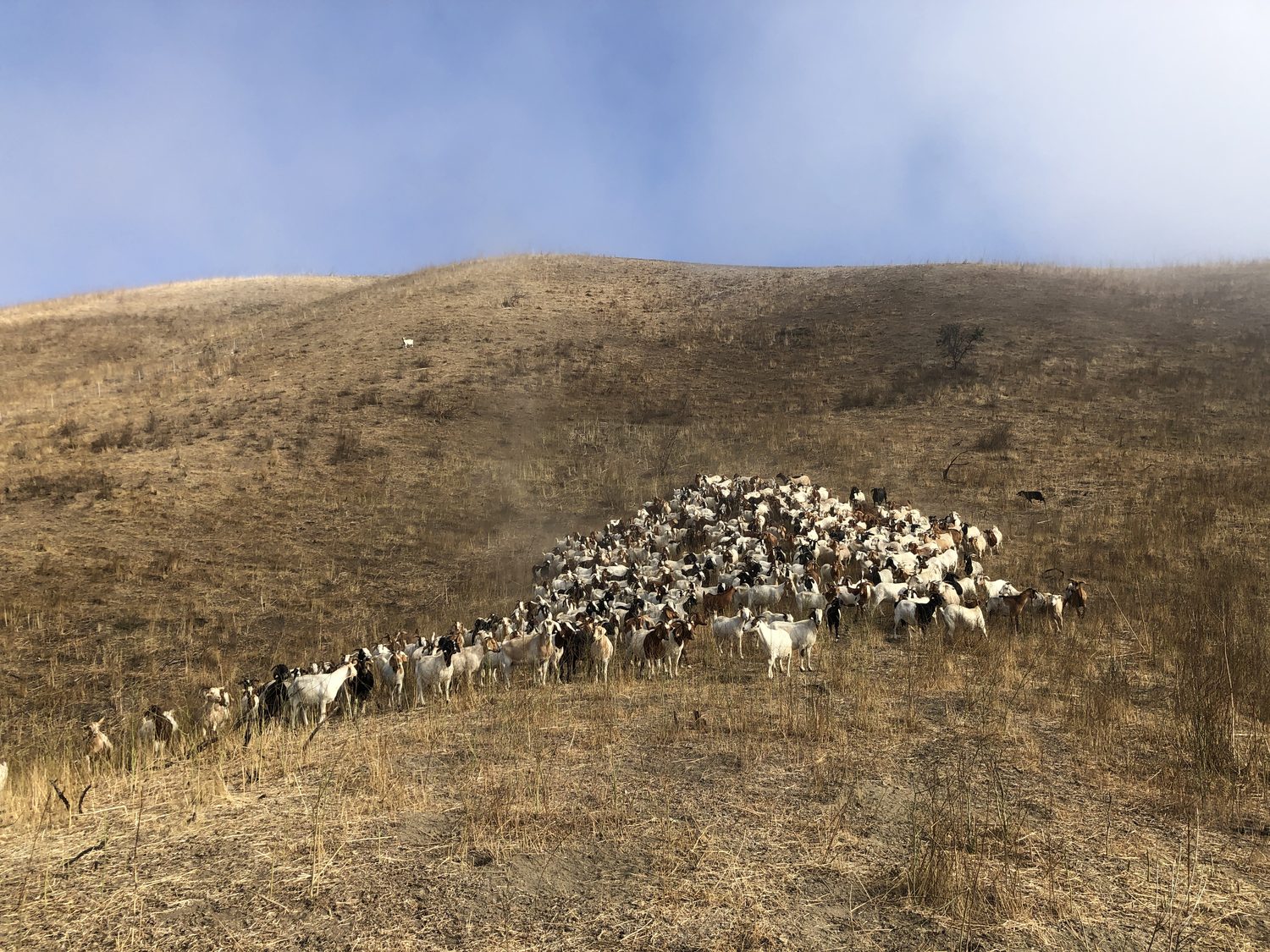
Targeted grazing is one of the tools available for reducing and breaking up that fuel, particularly on the steep, brushy ground where hand crews are slow and machines are unsafe. Goats will work slopes and rocky terrain, they eat the brush and ladder fuels rather than just cutting them, and they do it without the ignition risk that mowing carries in dry season. Fire agencies from Los Angeles County to Laguna Beach maintain their own fuel breaks this way.
It is worth being precise about the claim, though. Grazed ground does not stop a wind-driven crown fire. Nothing available to a property owner does. What a maintained fuel break can do is lower flame lengths and slow spread at the edge of a property, which gives crews somewhere defensible to stand and time to work — the outcome firefighters credited at the Reagan Presidential Library in 2019, where a herd had grazed a perimeter five months before the Easy Fire surrounded it.
Grazing is also not a substitute for the rest of the work. Ember-resistant Zone 0, screened vents, cleared gutters, and hardened construction do a different job, and in most post-fire investigations that job turns out to be the decisive one for whether a house survives.
The seasonal point
The reason the European fires are instructive right now is timing. The fuel burning outside Bordeaux this week grew during the wet months and cured through spring. The window to do something about it closed before the fire started.
Fuel reduction is scheduled work, not emergency work. Whatever method a property uses — grazing, mastication, hand crews, or a combination — the calendar matters more than the choice: the treatment has to happen before the vegetation cures, and it has to happen again the following year, because fuel grows back.